
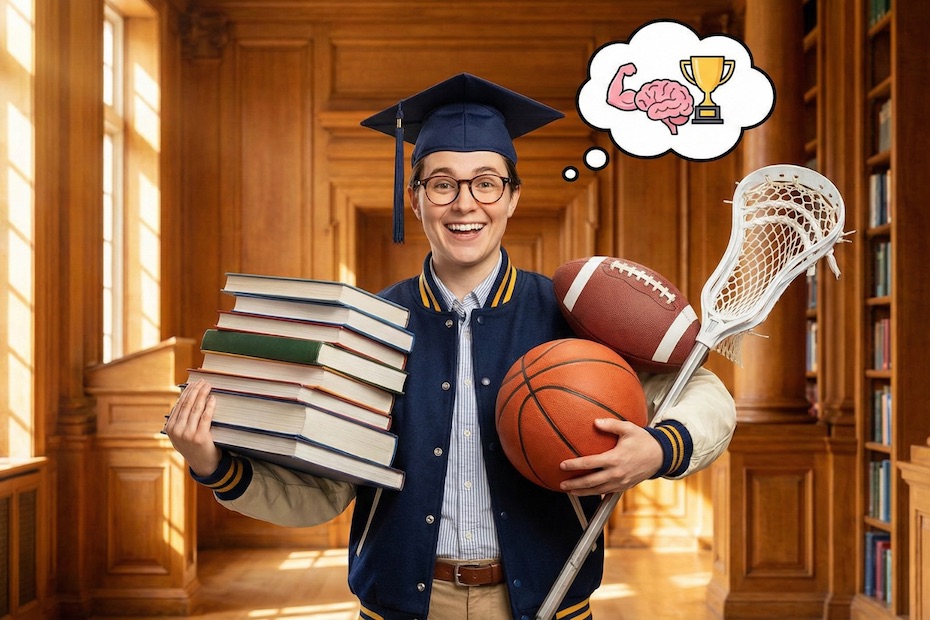
Look at you — balancing sports and academics like you’re auditioning for a motivational Netflix documentary. You sprint, sweat, compete, show up at 6 AM practices, and still expect your brain to function in algebra. Honestly? Bold move. But here’s the twist: the habits that make you a machine on the field also turn you into a quiet academic assassin in the classroom.
So here’s the question you didn’t know you were asking: Can the same discipline that gets you through drills also get you through homework without crying?
Spoiler: Yes. And sometimes with fewer tears.
Buckle up — it’s time to turn your athletic chaos into academic excellence without giving up your sanity (or your post-practice snacks).
Wait… Sports Discipline Actually Helps Me Study?
This is your first stage: the awakening. You start noticing that all those things you considered “coach yelling rituals” actually trained your brain. Showing up on time. Following instructions. Repeating tasks without collapsing emotionally. Turns out, academic success loves these traits.
Suddenly you’re asking yourself, “Have I been preparing for exams this whole time without knowing?” Yes. You’ve basically been in study bootcamp disguised as athletic training.
You realize discipline doesn’t magically appear when you sit at a desk — you’ve been building it during every sprint, drill, and questionable warm-up exercise your coach designed in the name of “team bonding.”
Time Management: The Skill You Didn’t Know You Had (But Your Coach Did)
You’ve been juggling practices, games, homework, snacks, sleep (barely), and social life as if you were running a Fortune 500 company out of your backpack. When you shift that same mentality to academics, everything changes.
You start blocking out homework time like it’s film review. You treat due dates like game days. You realize procrastination is the academic version of showing up to practice without your shoes — embarrassing and entirely avoidable.
This is where your inner CEO emerges: clipboard in one hand, color-coded schedule in the other, fully prepared to conquer your workload with “grind mode” energy.
Physical Training Makes My Brain Work Better? I Deserve a Trophy.
This is the part where science casually walks in and boosts your ego. Research shows that physical activity sharpens attention, boosts memory, and helps cognitive performance. Essentially, exercise helps your brain stop acting like it’s buffering at 3% Wi-Fi.
You notice that on days you train, you can actually focus on your homework instead of staring at the wall like you’re waiting for inspiration to fall from the sky. Your energy is better. Your motivation is higher. You even remember things without writing them on your hand.
As far as you’re concerned, athletic training is the pre-workout for your GPA.
Self-Discipline: The Secret Ingredient You Accidentally Developed
You know those moments when you push through another drill even though your legs are screaming, your lungs are negotiating, and your soul briefly leaves your body? That’s discipline — raw, unfiltered, slightly traumatic discipline.
Now take that same stubborn energy and apply it to studying.
Homework becomes reps. Projects become training cycles. Exams become tournaments where the prize is bragging rights and maybe a scholarship. You start grinding through assignments with the same ferocity you bring to game day.
Your teammates may not see it, but your GPA definitely does.
Teamwork in Sports Helps Me with Group Projects? This Is Suspicious.
You’ve spent years learning how to communicate on the field, strategize with teammates, understand different personalities, and deal with that one player who never listens but still insists they’re the MVP.
Guess what? That’s training for group projects.
You become the glue — the person who organizes tasks, identifies strengths, and prevents the group from collectively imploding. Collaboration becomes second nature because sports taught you how to succeed with others, not just next to them.
And yes, your ability to handle group chaos without screaming is now your academic superpower.
The Pitfalls: When Sports and School Fight for Custody of Your Time
This is the stage where reality tugs on your jersey.
Athletic commitment is amazing, but it can also be a black hole for your schedule. Practices get longer. Games run late. Travel drains your energy. Suddenly your planner looks like a puzzle that needs divine intervention.
Balance becomes non-negotiable. You learn to protect your study time the same way you protect your hydration bottle. You start saying no to things. You master efficiency because you simply don’t have the luxury to waste time.
Yes, it’s hard. But your discipline turns difficulty into manageable chaos.
Applying Athlete Mindset to Academics: The Final Form
This is the victory lap.
You take everything you’ve learned — routine, discipline, resilience, teamwork, focus — and merge it into your academic life.
You start setting goals like training benchmarks.
You track progress like season stats.
You push through academic slumps the same way you power through drills.
You realize consistency > talent (in sports and in school).
This is the stage where you stop seeing athletics and academics as two separate worlds. They’re just different arenas where your mindset determines your success.
How Athletic Discipline Improves Academics
- Builds study routines through consistent habits
- Improves focus and cognitive performance
- Strengthens time management and goal-setting
- Transfers teamwork and resilience to schoolwork
Your Playbook for Excellence Lives in You
Athletic discipline doesn’t automatically make you a straight-A student, but it gives you a head start most people never get: structure, grit, teamwork, and the belief that effort compounds over time. When you transfer those habits to academics, you build a rhythm that supports growth — and scholarship committees notice.
So keep training, keep studying, and keep building the habits that make you better in every arena. And remember: if you can survive conditioning drills, you can definitely survive calculus.

Cassandra Toroian is a sports-tech entrepreneur and CEO/co-founder of Ruley, the AI “e-referee” serving tennis, pickleball, padel, golf, and soccer. With 25+ years building companies—and a background in finance (MBA) plus Python training—she’s also co-founder of Volleybird and author of Don’t Buy the Bull. A former Division I tennis player, she’s focused on using AI to make sport fairer and more accessible.