
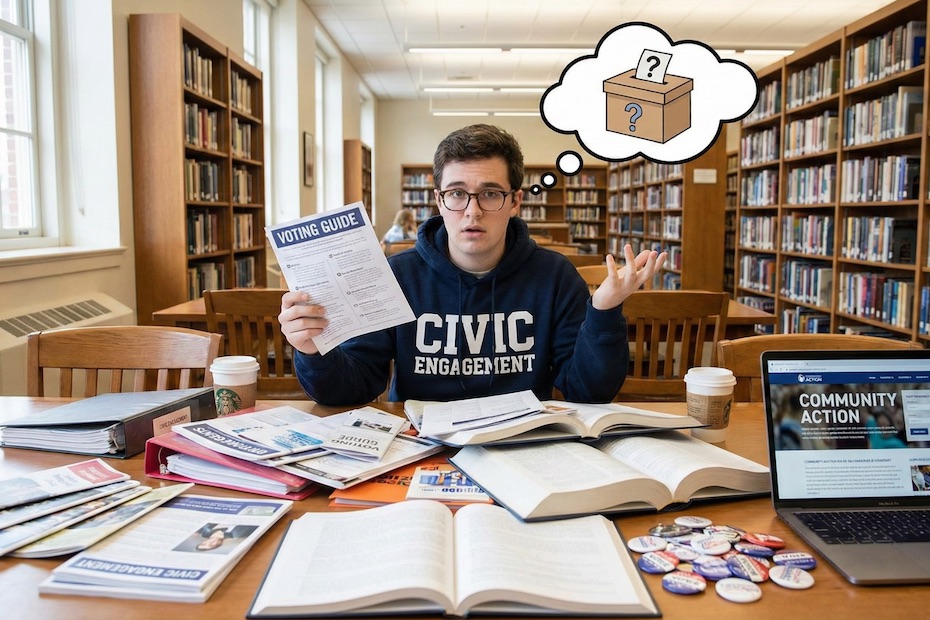
Look at you — walking around with the confidence of someone who just watched a political documentary and now thinks they’re the moral backbone of the Republic. You’ve decided it’s time to “get involved,” which is impressive, because half the country still forgets what midterm elections are.
But here you are, poised to become the student whose voice rings across the nation… or at least across your campus group chat. The real question is: how do you actually make your voice heard in American democracy without accidentally starting a meme war?
Well, buckle up. You’re about to discover that civic engagement isn’t just about dropping a ballot and patting yourself on the back. It’s a whole journey — dramatic, chaotic, educational, and occasionally fueled by cold brew.
Understanding Civic Engagement (AKA: What Are We Even Doing?)
You begin your democratic adventure with enthusiasm so bright it could power a small city. You’ve decided you want to be “civically engaged,” which sounds noble… until you realize you don’t fully know what that means.
Then you learn civic engagement is basically anything that helps shape your community — voting, volunteering, contacting officials, signing petitions, attending public meetings, convincing your roommate recycling does matter, the whole buffet.
Suddenly you’re Googling definitions like you’re preparing for a pop quiz. But you’re committed. You even bookmark a government website — a historic moment for any student.
Why Your Vote Matters (Yes, Even Your Vote)
Here’s where you step into the realization that voting isn’t just something adults do after brunch. In the 2024 U.S. election, youth turnout reached around 47%, which means nearly half of people your age were out there influencing the direction of the country. The other half? Probably sleeping through their civic responsibilities like it was an 8 a.m. lecture.
You start feeling the weight of it — if millions of students actually showed up at the polls, national outcomes could shift dramatically. Suddenly you’re staring at your voter registration form with newfound purpose, like Simba gazing across the Pride Lands.
You’re beginning to get it: voting isn’t just a right. It’s your main microphone in democracy.
Registering to Vote: Your First Mini-Boss Battle
Now that you’ve accepted voting supremacy, you attempt to register. You confidently fill out the form… then realize you typed your address wrong. You try again, misread a requirement, then realize your state has deadlines you definitely missed last year.
Welcome to the bureaucracy marathon.
But you persist. You verify your registration status like a seasoned adult. You even learn where your polling location is, which puts you in the top tier of student voters nationwide.
With your registration confirmed, you feel unstoppable — like you’ve unlocked a new achievement title: Functional Citizen.
Overcoming the Barriers That Stopped 2024 Voters
Now comes the insight stage: the 2024 youth turnout research. You learn that many young non-voters didn’t participate because they didn’t like the candidates, weren’t interested, or felt disconnected. About 75% said they felt informed enough to vote… and then still didn’t.
This stage hits hard. You begin seeing how easy it is to get discouraged, distracted, or disillusioned. You remember that time you skipped a group project meeting because the vibes were off. Democracy works the same way — except with slightly higher stakes.
But you’re not backing down. You decide you’ll show up, even if the system occasionally feels like a malfunctioning vending machine.
Beyond Voting: When Democracy Needs More Than a Checkmark
Just when you think voting is the whole game, you discover an entire world of civic action. American democracy actually needs people who participate between elections — shocking, I know.
Here’s where you explore the non-ballot activities that give your voice more staying power than your Wi-Fi signal:
- Attending community meetings and campus forums
- Signing petitions that push for policy change
- Volunteering for local organizations
- Contacting elected officials directly
- Participating in peaceful activism
- Helping peers understand issues
Suddenly you feel like an NPC who just unlocked the hidden map of democracy. You even consider joining a student-led civic group, which is basically the Avengers for people who care about municipal budgets.
The Real Struggles Students Face — And Yes, You Can Beat Them
Here comes your montage scene — the part of the movie where the hero (you) encounters obstacles. Time, stress, transportation, confusion about ballots… you name it. You see from national studies that students consistently struggle with logistics and motivation.
You relate deeply. You remember the struggle of balancing three classes, one part-time job, and keeping your houseplants alive.
But civic engagement doesn’t need perfection. It needs persistence.
You figure out solutions: early voting, absentee ballots, campus civic centers, and accountability buddies. You become someone who actually helps others register. Your power is growing and your plants might even survive this semester.
Long-Term Impact: The Part Where Future You Thanks Present You
Now you see the big picture. Civic engagement doesn’t just fix issues today — it builds habits that shape your entire adult life. Students who participate early tend to stay involved, influence their communities, and understand how policy shapes their opportunities.
Future you — the successful, thriving, tax-paying legend — will appreciate that today you stepped into the arena instead of watching from the metaphorical bleachers.
You realize democracy isn’t a once-in-a-while event. It’s a practice. And you’re now someone who participates rather than spectates.
How Students Can Engage in American Democracy
- Register to vote early
- Join campus civic groups
- Contact local officials
- Participate in community events
- Support causes through petitions and volunteering
Congrats, You’re Officially a Democracy User.
You’ve traveled from confusion to competence, from spectator to participant, from “I don’t know what civic engagement means” to “Democracy runs on me.” Your previous skills helped, but they didn’t replace effort. Civic involvement rewards the patient, the curious, and the determined.
Keep learning. Keep showing up. Keep using your voice, because democracy only works when people like you refuse to mute themselves.
Bring snacks, water, and a healthy dose of sarcasm — democracy is a long-term group project, and you’re definitely stuck in it with the rest of us.

Cassandra Toroian is a sports-tech entrepreneur and CEO/co-founder of Ruley, the AI “e-referee” serving tennis, pickleball, padel, golf, and soccer. With 25+ years building companies—and a background in finance (MBA) plus Python training—she’s also co-founder of Volleybird and author of Don’t Buy the Bull. A former Division I tennis player, she’s focused on using AI to make sport fairer and more accessible.